
These are my VirtualBox notes.
Official Sites
- Oracle VirtualBox
- End user forums for VirtualBox
- Licensing: Frequently Asked Questions | Oracle - This page answers questions you may have about VirtualBox and its licensing.
- Oracle VM VirtualBox - Downloads | Oracle Technology Network | Oracle - Download the latest version of Oracle VM VirtualBox, VBox GuestAdditions and manuals.
- User Guide for Release 7.2 | Oracle - No meta description
General
- Release the cursor from the VM
Right Ctrl key
- How to release mouse capture in VirtualBox? | Stack Exchange
- Virtualbox shows you what key to press at the bottom right of the Guest OS windows.
- You might be able to change this hotkey.
- This is known as the
Host Key
- How to release mouse capture in VirtualBox? | Stack Exchange
- Release the cursor from the VM when in scaled mode
Right Ctrl + C
- How to Exit VirtualBox Scaled Mode? | Appuals - While using VirtualBox to emulate another operating system, many users unknowingly enter full-screen or scaled mode. This can be frustrating because it
- Extension Pack
The main installer has option for USB 3.0, so I am not sure if this will prompt to add the extension pack or if it part of the main program.
- How to Install VirtualBox Extension Pack: Detailed Overview | NAKIVO - Installing VirtualBox Extension Pack allows you to unlock advanced VirtualBox features. Read how to install VirtualBox Extension Pack on Mac and Windows.
- Do I need to install VirtualBox Extension Pack and dkms? | Ask Ubunutu
- VirtualBox Extension Pack only need for USB 2.0 and USB 3.0 devices, VirtualBox RDP, disk encryption, NVMe and PXE boot for Intel cards
- 1.5. Installing Oracle VM VirtualBox and Extension Packs - Chapter 1. First Steps | Oracle
- "VirtualBox Extension Pack only need for USB 2.0 and USB 3.0 devices," but USB 1.1 is available as part of the main program so you can access USB slowly with out the extension pack.
- Oracle VirtualBox USB Support Guide: Enable USB 1.1/2.0/3.0, Filters & Fixes | cleverence - Comprehensive guide to USB support in Oracle VM VirtualBox: enable USB 1.1/2.0/3.0 with Extension Pack, create device filters, pass through scanners/printers, host permissions, CLI tips, and troubleshooting best practices.
- 3.11. USB Support | Oracle
- VirtualBox 7.2 fixes 3D guests, adds Arm-on-Arm support
- It's important not to confuse the VirtualBox Extension Pack with the VirtualBox Guest
- Our Extensions menu is blissfully empty, because this screen is where you would find the VirtualBox Extension Pack. This is a free download – an optional and separately licensed installation package – but we don't recommend it. It's handy, but it costs money to use it in production. The Extension Pack adds support for USB 3.0 and USB passthrough, network-booting VMs, remote access to VMs over RDP, and encrypting their virtual disks. For us, it's not a deal-breaker to live without any of these features – we don't need any of them.
- How to buy Extension Pack? - virtualbox.org
- Information on how and if you should buy the Extension Pack.
- Guest addition license GPL or PUEL? - virtualbox.org
- Q:
- The guest addition iso coming from http://download.virtualbox.org/virtualbox/4.3.18 has a license file which says it is on the proprietary PUEL license.
- But the guest additions is also present as an iso, bundled in the binary distribution of VirtualBox release under the term of GPLv2: https://www.virtualbox.org/wiki/Downloads. This last iso does not contain a license file (but the whole VirtualBox package has one: GPL2). The iso is part of the GPLv2 binaries, not of the extension pack.
- So what? Is there a difference in functionality between these two iso?
- A:
- The VirtualBox Guest Additions are GPLv2, the Oracle VM VirtualBox Extension Pack is PUEL.
- Q:
- Guest Additions
- Chapter 4. Guest Additions | Oracle
- For any serious and interactive use, the Oracle VM VirtualBox Guest Additions will make your life much easier by providing closer integration between host and guest and improving the interactive performance of guest systems.
- This chapter describes the Guest Additions in detail.
- How can I tell if the VirtualBox guest additions were installed on an Ubuntu VM? | Ask Ubuntu - How can I tell if the guest additions are installed on a VirtualBox VM with no X Windows installed?
- using virtual box in company pc - virtualbox.org - Do I need a licence if I install virtual box in PC of my company ?
- How do I install VirtualBox Guest Additions on Windows 7? | tom's Hardware - No meta description
- Chapter 4. Guest Additions | Oracle
- phpvirtualbox
- GitHub - phpvirtualbox/phpvirtualbox - A Web interface to manage and access VirtualBox machines.
- Overview of Using 'PhpVirtualBox' to Manage VirtualBox via Web Browser in Linux - YouTube | Lawrence Systems
- phpVirtualBox | SourceForge
- An open source, AJAX implementation of the VirtualBox user interface written in PHP. As a modern web interface, it allows you to access and control remote VirtualBox instances.
- phpVirtualBox is designed to allow users to administer VirtualBox in a headless environment - mirroring the VirtualBox GUI through its web interface.
- Cannot change Boot order in settings
- Legacy BIOS VMs:
- Press F12 during VM startup to select a boot device for that session
- If the VM uses EFI:
- Use the ESC key during startup or adjust disk/controller order for a workaround.
- If you're already using EFI/UEFI, this is different. The EFI firmware has its own NVRAM boot entries.
- VirtualBox doesn't provide a normal GUI option for rearranging those EFI entries.
- You need to modify the EFI variables/NVRAM, typically from inside the VM using efibootmgr on Linux, or using the UEFI shell. For example from Linux: efibootmgr
- Adjust Disk/Controller Order: VirtualBox prioritizes the disk attached to Port 0 of a SATA/IDE controller. Moving your bootable disk to Port 0 can enforce boot priority.
- Legacy BIOS VMs:
- Storage Devices are missing in settings (Settings --> Storage --> Devices)
- At the top-left, select expert mode and the hidden stuff will appear
- Sometimes there is a blank line at the top, in basic mode, which is the parent controller (buggy)
- Try removing everything by clicking the button until it is greyed out, save settings and start again.
- Additionally, after wiping all storage devices, save and then make your changes.
- Virtualbox keeps toggling Num Lock
- You will notice this if you have an on-screen display for Num Lock.
- This is quite normal as the Num Lock state is swapped to match which machine(or host) has focus.
- Disable the on-screen notification.
- Windows XP taking forever to load / Crashes with a CPU error (Windows 11 host)
- Cause:
- This is caused by Core Isolation being enabled.
- Hyper-V running underneath VirtualBox is the single most common cause of exactly this error on XP guests on modern Windows hosts.
- Solution:
- Disable Core Isolation / Disable Hyper-V
- Settings --> Device security --> Core Isolation --> Memory integrity: Off
- You will need to reboot.
- This resolves this exact symptom for a lot of people, because Hyper-V's virtualization-based security conflicts with how VirtualBox exposes the CPU to an XP guest.
- Links:
- Device Security in the Windows Security App | Microsoft Support - Learn how to access Windows device security settings in Windows Security to help protect your device from malicious software.
- Virtualbox - Virtualization is Enabled but not Working - GeeksforGeeks - Oracle VM VirtualBox requires Intel VT-x or AMD-V hardware virtualization to run 64-bit virtual machines. Sometimes, virtualization is enabled in the BIOS/UEFI, but VirtualBox still reports errors or cannot start virtual machines due to operating system conflicts or incorrect configuration.
- Fix WARNING: neither Intel VT-x or AMD-V found - VirtualBox - Windows 11 · GitHub - Fix WARNING: neither Intel VT-x or AMD-V found - VirtualBox - Windows 11
- Problems with "Memory Integrity" - virtualbox.org - I'm using Win 11 (22H2 / 22621.1485), without using Hyper-V, and I'm not able to run the VMs.
- Memory integrity / Core Isolation not available in a VM ???? | Windows 11 Forum
- This might only be on W11 VM's running on Linux (KVM/QEMU) where there's plenty of memory integrity and core isolation handled by the Linux HOST Hypervisor. Even if enabled it's still off after VM reboot!
- It's the same on Oracle VirtualBox with Windows 11 VMs; and you have to choose the "Dismiss" option to silence the security warnings. Core Isolation also has to be turned off on some Host hardware setups if there is too great an impact on VM performance. Microsoft's own advice is that its Virtualisation-Based Secuity (VBS) features are incompatible with third-party virtualisation products that rely on direct access to the hardware acceleration features provided by VT-x/AMD-V and need to be disabled to run such software.
- Cause:
- Installation
- Installation Wizard
- Python support (option when you install)
- This package contains Python scripting support for the Oracle VM VirtualBox API
- Starting VirtualBox VM using Python - How can I start a virtual machine from virtualbox as headless using pyvb modules?
- pyvbox · PyPI - Complete implementation of VirtualBox's COM API with a Pythonic interface
- VirtualBox upgrade - leave shortcuts on during installation wizard
- When you run the VirtualBox upgrade, leave desktop shortcut selected in the wizard otherwise the one present on the desktop will be removed.
- [Fixed] VirtualBox Needs Microsoft Visual C++ 2019 Redistributable Package - A quick tutorial to show you how to fix the error "VirtualBox Needs Microsoft Visual C++ 2019 Redistributable Package".
- Python support (option when you install)
- How to Install VirtualBox on Ubuntu Linux [3 Simple Ways] | It's FOSS - This beginner’s tutorial explains various ways to install VirtualBox on Ubuntu and other Debian-based Linux distributions.
- Installation Wizard
- mtrr: your CPUs had inconsistent variable MTRR settings
- This error might be caused by `Core Isolation` settings.
- Make a disk with fixed size and do snapshots ?
- I guess when the snapshots are removed, the VM will revert to a single disk again. While there are snapshots, effectively a parallel dynamic disk/file will be run along side it as an overlay. This will affect performance.
- Don't run snapshots on a live production server.
- Copy and Paste
- virtualbox.org • View topic - Input -> Keyboard -> "Paste as text (send characters)"
- Input -> Keyboard -> "Paste as text (send characters)" - Page 2 - virtualbox.org - Well, without too much fanfare, that feature was introduced in VirtualBox 5.2.0.
- How to Copy & Paste Between a VirtualBox Host Machine & a Guest Machine | How-to-Geek - Good news: It doesn't require Guest Additions.
- virtualbox.org • View topic - Input -> Keyboard -> "Paste as text (send characters)"
- Preallocate or Fixed disk (move to disk image managment)
- Best practices for VHDX: Dynamic vs. Fixed size disks | Microsoft Learn - However, I could not find any clear statement from MSFT that dynamically expanding .vhdx files are OK or recommended for production environments.
- Dynamic disk preallocate - Virtualization - Spiceworks Community - I have a virtual machine where the drives would ideally be a fixed size for best performance. As the storage is going to grow over time a dynamic disk is preferred. I’m wondering is it possible to have my cake and eat it too.
- Dynamically allocated storage exploded to full size without warning - virtualbox.org
- Assuming that the Windows 10 Installer didn't actually load 460GB of data onto the VM (and then deleted most of it): What may have caused the to spontaneously expand?
- Can I shrink the VDI back to a more appropriate actual size (there is only 70GB or so of actual data on the VDI)?
- Assuming that the Windows 10 Installer didn't actually load 460GB of data onto the VM (and then deleted most of it): What may have caused the to spontaneously expand?
- Missing Device icons at the bottom of the window
- Can't install Guest Additions - (Missing 'Devices' Menu on host) | Super User
- The top menu is wrong (Virtualbox 4.2, Windows 7)
- When in seamless/fullscreen mode, you can hit
Host + Homekey to popup the toolbar dialog menu.
- Suddenly missing USB devices W10 Host / WinXP Guest after some update? - virtualbox.org - Suddenly I am experiencing an issue with the VB in confing of W10 Host / WinXP Guest on multiple machines with this config.
- I can't see menu bar in VM window - virtualbox.org
- Hi, I recently installed w2008 x64 over w2008 x86, but suddenly menu bar in VM window disappeared, so I can't install add-ons neither insert ctrl+alt+supr and so on.
- I was trying to configure that from Settings/General/Advanced tab/Show menu bar/toolbar By trying both options, but it's still the same. What's happening here?
- Scaled mode with no host key - virtualbox.org
- I turned off my host key a while back, because it interfered with some app. I didn't know about scaled mode at the time, and expected I could always use the menus.
- I'm in scaled mode and have no menus.
- Used "scaled mode" in display size.Cant get out of it. - virtualbox.org
- Use the Host+C scale mode toggle
- Host = right ctrl unless changed
- Can't install Guest Additions - (Missing 'Devices' Menu on host) | Super User
- Parallel Port
- Can't give VirtualBox guest OS access to host physical LPT1 port | Super Users
- How to enable parallel port? | Reddit
- I was running WinXP in VirtualBox v4.0.x. It is dedicated for a legacy parallel/LPT port device that only has drivers for WinXP 32bit.
- The host is Win7 x64.
- It was working just fine for a long time. Recently, I updated VirtualBox to the latest v6.1.0 and now when I startup the WinXP vm, I get this error about no parallel port. And I can't find any settings to enable it.
- Enabling and Configuring Parallel (LPTx) Ports - virtualbox.org
- On several occasions the mods have been asked for instructions on how to enable and configure LPT (parallel port) passthrough in a guest.
- LPT passthrough is a feature which has been requested for years, and was finally implemented with very little fanfare in VirtualBox v4.2.0 (*).
- The release logs and documentation make only passing mention of it, which possibly reflects a low level of confidence the devs have in this new feature.
- Basically, it's an (almost) undocumented feature, so if you can't get it to work... well just don't expect too much.
- Passthrough questions - virtualbox.org
- Should I be able to do the USB to LPT on the host machine and just pass through the LPT port?
- Should I be able to pass through an AGP or PCI video card to the guest while keeping the onboard video for the host?
Anything else I'm not thinking of?
- VirtualBox multicore issue
- Can't select more than 1 CPU - virtualbox.org
- https://www.virtualbox.org/ticket/19561 #19561 (Nested virtualization BUG: soft lockup - CPU#4 stuck for 22s! [CPU 1/KVM:28838]) – Oracle VM VirtualBox
- https://forums.virtualbox.org/viewtopic.php?f=8&t=93904 virtualbox.org • View topic - Kernel Panic - HyperV acceleration, macOS 10.14.5 Mojave
- https://forums.virtualbox.org/viewtopic.php?f=8&t=61355 virtualbox.org • View topic - Multiple processors
- Snapshots
- Virtualbox, merging snapshots and base disk | Super User - I would like to merge the current development branch of snapshots together with the base disk, but I am unsure if the following command would produce the correct outcome.
- Is quiescing a VM during a backup necessary for a consistent snapshot of the filesystem? | Super User - Do I need to 'quiesce' a running VM to get a consistent snapshot of the disk at a point in time?
- Automatically create snapshot before launching VirtualBox VM? | Super User - Does anyone have a script or know how to write one to automatically take a snapshot of a VM before launching it for use?
- VirtualBox: How to Use Snapshots - YouTube - In this video, we will be learning how to use snapshots within VirtualBox. Snapshots are great for saving a machine state and being able to revert back to a previous time.
- Virtuabox vs VMWare vs Hyper-V
- VirtualBox vs. VMware Player: The Best Virtual Machine for Windows - Which virtual machine software should you use? VirtualBox and VMware Player are two of the best options, so how do you choose between them?
- VMware vs VirtualBox: Best Tool for Virtualization | TechnologyAdvice - In the IT environment, desktop virtualization is an extremely useful tool. Explore & compare top features of today's industry leaders, VMware vs VirtualBox.
- Comparison between Client Hyper-V and VirtualBox - BDRSuite - Learn about the unique features of Client Hyper-V and VirtualBox. For a better understanding, explore the differences between these hypervisors.
- Should I enable PAE/NX ?
- Yes, for all modern OSes. This should only need turning of for really old OSes.
- This option does control 2 separate but related features.
- DEP requires NX
- What is PAE/NX in VirtualBox? | Quora
- PAE (Physical Address Extension)
- NX (No-Execute), also called XD (eXecute Disable) on Intel
- Default choice: Enable PAE/NX for modern guests unless you have a specific compatibility reason not to. It improves security (NX) and enables expanded memory for 32-bit guests (PAE).
- Enable it for modern OSes and for 32-bit guests that must access >4 GiB or require PAE.
- In-depth answer.
- When do I have to use PAE/NX? | Super User
- Now, let's return to the fact that the checkbox is for PAE/NX. The same tricks used to make more memory locations accessible can also be used to add in an NX-bit. Again from the second paragraph of the PAE Wikipedia article:
- In-depth answer.
- Unlocking the Power of PAE NX in VirtualBox: A Comprehensive Guide - SmartTechSavvy - In this article, we will delve into the world of PAE NX in VirtualBox, exploring what it is, how it works, and its benefits and limitations.
- Physical Address Extension - Wikipedia
- NX bit - Wikipedia
- How to Enable Processor-Based Security: DEP, NX/XD, Memory Integrity | iTechguides
- How to enable processor-based security in Windows: check and configure DEP with NX/XD and BCDEdit, then enable Memory integrity for VBS/HVCI when hardware and drivers support it.
- Hardware DEP uses NX on AMD processors or XD on Intel processors to prevent code from executing in memory pages marked for data.
- Older applications and drivers can fail when DEP or Memory integrity blocks behavior that is unsafe, obsolete, unsigned, or incompatible.
- Windows DEP Explained: How It Protects Memory and How to Manage It | WindowsForum
- Data Execution Prevention (DEP) is one of those quietly powerful Windows defenses that rarely makes headlines — until it blocks something you’re trying to run.
- Built to stop code from executing in memory regions reserved for data, DEP reduces the damage that buffer overflows and similar memory exploits can cause.
- This feature uses both CPU hardware flags (NX/XD) and software fallbacks to enforce execution policies, and it’s enabled by default on modern Windows installations.
- For most users DEP should stay turned on; for administrators and power users, understanding how DEP works, how to check its status, and how to safely troubleshoot exceptions is essential to balancing compatibility and security.
Virtual Drive's Serial Number
- The drive's serial number can from 2 places
- You have manually added one to virtual machine, after adding the drive, which is linked to the specific drive by the UUID in the VM's config (I think).
- VirtualBox automatically generates one on the fly using the UUID using an algorithm.
- To convert a VirtualBox disk UUID (Universally Unique Identifier) into a hard drive serial number, use this algorithm:
Drive UUID: {e21966cd-8006-4515-b034-b22634edb85c} --> Drive Serial: VBe21966cd-5cb8ed341- Strip the dashes from the UUID.
- Group 1 = the first 8 hex characters, unchanged.
- Group 2 = the last 8 hex characters, with the 4 bytes reversed
- (i.e. split into byte-pairs AA BB CC DD and reorder to DD CC BB AA).
- Serial =
VB<Group1>-<Group2>
- The drive serial numbers for SSDs are broken
- They all show as
VB1234-56789
- I have reported it here: [Bug]: Multiple NVME virtual devices shown with same device ORCL_VBOX_NMVE_VER12 can't be controlled by device software · Issue #828 · VirtualBox/virtualbox · GitHub
- They all show as
- How to see the drive serials in the GUI
- You cannot
- I have requested it here: [Req]: Show the drives serial number in the GUI (HDD/SSD/NVMe) · Issue #856 · VirtualBox/virtualbox · GitHub
- Manually set the drive's serial number
- 9.7.2. Configuring the Hard Disk Vendor Product Data (VPD) - Chapter 9. Advanced Topics - Oracle VM VirtualBox reports vendor product data for its virtual hard disks which consist of hard disk serial number, firmware revision and model number. These can be changed using the following commands:
- Virtualbox Modifying the serial number of the hard drive, etc. example - Recently installed a software for research, you need to use the hard drive serial number to verify. Before the other server has been installed, if you can change the current hard disk's serial number and the original server's hard disk to match the lack of a lot of registration-related trouble. According to this idea, I found it in VBox's help.
- VPD serial number change for hard disk not working. - virtualbox.org
- Read the serial number
Tutorials
- A Complete Guide to Using VirtualBox on Your Computer | NAKIVO - VirtualBox is designed to run VMs on your physical machine without reinstalling your OS on a physical machine. Learn how to use VirtualBox on your computer
- Use VirtualBox's Seamless Mode or VMware's Unity Mode to Seamlessly Run Programs From a Virtual Machine | How-to-Geek - Virtual machines generally run guest operating systems and their programs in a single window.
- VirtualBox Tutorial Building Virtual Machines, Snapshots, Import, Export, Mapping USB & More! - YouTube | Lawrence Systems
- install graphic drivers in VirtualBox - YouTube - How to install graphic driver in Virtual Box
- https://forums.virtualbox.org/viewtopic.php?f=11&t=16616 virtualbox.org • View topic - how to setup network driver in windows xp (guest)
- Clone Virtual Machines in VirtualBox (Linked Clone, CloneVDI and CLI) - This post explains all possible methods to clone Virtual Machines in VirtualBox by GUI, CloneVDI Tool and CLI on a Windows host computer.
- Virtualization on Windows 10 with Virtual Box, Hyper-V and Docker Containers | Conclusion AMIS Technology Blog
Misc
- https://forums.virtualbox.org/viewtopic.php?f=2&t=48019 Ethernet Driver
- https://forums.virtualbox.org/viewtopic.php?f=6&t=49119 Success! Use Task Scheduler to create auto VM start/stop
- How to rename a VirtualBox virtual machine (VM)? | Super User - How can I change the virtual machine's display name (displayed at the left-side pane of VirtualBox QT gui)?
- https://forums.virtualbox.org/viewtopic.php?f=2&t=48927 virtualbox.org • View topic - Max resolution 1152 x 864
Startup and shutdown
- Shutdown issue (interface has active connections)
- VirtualBox Interface has active connections error message when shutting down | TheWindowsClub
- In this article, we will describe the methods to fix the issue where VirtualBox Interface won’t allow PC to shut down.
- Fix: VirtualBox Interface does not Allow PC to Shut Down | Appauls
- You may encounter the Virtual Box Interface issue while shutting down your PC if you are using an older version of the BlueStacks emulator.
- Moreover, improper configuration of the Task Manager priorities of the BlueStacks processes may also cause the error under discussion.
- The user encounters the issue when he tries to shut down his PC but could not (unless he forces the system to shut down anyway).
- VirtualBox Interface has active connections error message when shutting down | TheWindowsClub
- Graceful Shutdown / ACPI Shutdown
- Gracefully power down first because you need to finish all requests of the server before shutting down to prevent data corruption in your MySQL databases etc..
- How to safely shutdown Guest OS in VirtualBox using command line | Ask Ubuntu
VBoxManage controlvm Ubuntu acpipowerbutton
VBoxManage controlvm Ubuntu poweroff
- difference between send shutdown signal and poweroff the machine in virtualbox | superuser
- Send the shutdown signal. This will send an ACPI shutdown signal to the virtual machine, which has the same effect as if you had pressed the power button on a real computer. This should trigger a proper shutdown mechanism from within the VM.
- Power off the machine: With this option, Oracle VM VirtualBox also stops running the virtual machine, but without saving its state.
- Note if the virtual machine OS can react to ACPI shutdown signal then it can most likely initiate shutdown procedure by itself, from the inside.
- How to automatically start and shut down VirtualBox machines? | Stack Exchange
- Headless Mode
- Start a VM in Headless mode with a shortcut
Shortcut name: CWP - Headless

Target: "C:\Program Files\VirtualBox\VBoxManage.exe" startvm CWP --type headless

Start in: "C:\Program Files\VirtualBox"s
- 7.1.2. VBoxHeadless, the Remote Desktop Server - Chapter 7. Remote Virtual Machines | Oracle
- While any VM started from VirtualBox Manager is capable of running virtual machines remotely, it is not convenient to have to run the full GUI if you never want to have VMs displayed locally in the first place.
- Oracle VM VirtualBox therefore comes with a front-end called VBoxHeadless, which produces no visible output on the host at all, but still can optionally deliver VRDP data.
- This front-end has no dependencies on the X Window system on Linux and Oracle Solaris hosts.
- 8.19. VBoxManage startvm - Chapter 8. VBoxManage
- The
VBoxManage startvmcommand starts an Oracle VM VirtualBox virtual machine (VM) that is in the Powered Off or Saved state.
- The
- Start a VM in Headless mode with a shortcut
Mount a RAW drive
- 9.7.1. Using a Raw Host Hard Disk From a Guest - Chapter 9. Advanced Topics | Oracle
- Oracle VM VirtualBox can present either entire physical hard disks or selected partitions as virtual disks to virtual machines.
- With Oracle VM VirtualBox, this type of access is called raw hard disk access.
- It enables a guest operating system to access its virtual hard disk without going through the host OS file system.
- How to Use a Physical Hard Drive with a VirtualBox VM | ServerWatch - This guide will show you how to use a physical hard drive with a VirtualBox virtual machine, plus pros and cons of that approach.
- Using RAW Devices In VirtualBox VMs | HowtoForge
- Usually, VirtualBox creates its virtual machines in disk images (.vdi, .vmdk, etc.).
- This tutorial explains how you can use RAW devices from the host (partitions, LVM volumes, etc.) and create a VirtualBox VM in it.
- I will also explain how to mount a RAW device in an existing VM
- Use physical harddisk in Virtual Box | Super User - Using Virtual Box, how can I install an OS to a secondary, physical disk, and boot it in both (at separate times) Virtual Box, and as a typical secondary OS install?
- https://forums.virtualbox.org/viewtopic.php?f=6&t=38914 - virtualbox.org • View topic - VM on RAW disk on Windows 7 host
- Use VirtualBox to boot a physical drive/partition [duplicate] | Super User - I have two partitions on my hard drive, one for Windows and one for linux. I would like to use VirtualBox in Linux to boot the Windows partition as a virtual machine. How can I acheive this?
- Convert your Windows install into a VM on Linux | Opensource.com - I use VirtualBox frequently to create virtual machines for testing new versions of Fedora, new application programs, and lots of administrative tools like Ansible.
- 9.9. Advanced storage configuration | Oracle VM VirtualBox - Document Help - Starting with version 1.4, as an alternative to using virtual disk images (as described in detail in Chapter 5, Virtual storage), VirtualBox can also present either entire physical hard disks or selected partitions thereof as virtual disks to virtual machines.
Backing Up a Live Server
- Backup Strategies for VirtualBox Guests - Oracle Forums - How do others handle their backups for guests running Oracle Database? Does anyone use (and trust) snapshots for VM guests that might be more tolerant of that approach?
- ttps://forums.virtualbox.org/viewtopic.php?f=2&t=84297 virtualbox.org • View topic - Is there support for VSS quiescing - required for MSSQL consistency
- Can I backup a running virtualbox Virtual machine? | Super User - Is it possible to back-up the VM including the current state and get it up and running again when my machine has been updated? And if so what is the best way to do this?
- Backing up Virtual Machines in VirtualBox | OpenSource Connections - This is, of course, problematic as CrashPlan is most likely running its backup while Im actively working in my virtual machine. How can I have any guarantee that that image is in any kind of consistent state?
- VirtualBox: Creating Backups & Clones Of Running Virtual Machines (No Downtime) With LVM Snapshots | HowtoForge
- If you use LVM volumes for your VirtualBox VMs (as shown in the tutorial Using RAW Devices In VirtualBox VMs), you can create backups and clones of a running VM without shutting it down.
- This tutorial shows just that: using LVM snapshots to create backups and clones of running VirtualBox VMs without downtime.
- For automating a full backup of a VM, is exporting as an appliance better than cloning the VM? | Super User - Various questions
- https://forums.virtualbox.org/viewtopic.php?f=6&t=74793 virtualbox.org • View topic - Backup script for Windows OS (BATCH)
Performance
Host Machine
- Get a newer PC with at least 16GB RAM and a modern prosesor with loads of cores
- Put Your Virtual Machines on a Solid-State Drive system rather than traitional drives for your host
- Ensure Intel VT-x or AMD-V Is Enabled in the BIOS (VirtualBox wont run without this now)
- This stops windows intercepting opcodes passed to the CPU by the virtualization technologies
- Exclude Virtual Machine Directories In Your Antivirus
- Change Power Plan to High Performance
Control Panel --> Power Options --> Change Plan Settings
- Disable Hyper-V & Windows hypervisor (wintips)
- Navigate to
Control Panel > Programs and Features > Turn Windows features on or off: Disable the following- Containers * (off by default)
- Hyper-V * (off by default)
- Virtual Machine Platform (off by default)
- Windows Hypervisor Platform (off by default)
- Windows Sandbox (off by default)
- * Note: The 'Containers' and the 'Hyper-V' features exists only in Windows 10 PRO.
bcdedit /set hypervisorlaunchtype off
- Navigate to
- make sure windows updates are all applied as these usually cause a general slow down in your PC.
- My system will not download or install them unless I click to do so.
- Having the latest VirtualBox is probably a good thing.
- Disable `Core Isolation` as this has known performance issues especially with older OSes.
- See notes on this elsewhere, but only disable this if you need to.
- How to Disable VBS and Speed Up Windows 11 or 10 | Tom's Hardware - Virtualization Based Security can slow apps (and games) down by 5 to 15%.
- Use nVME drives as they are quicker adn can handle modern disk formats better.
- The Complete Guide to Speeding Up Your Virtual Machines | How-To-Geek - Virtual machines are demanding beasts, providing virtual hardware and running multiple operating systems on your computer at once.
- Speed up a VirtualBox Virtual Machine and make it run faster | The Windows Club
- The speed and performance of a Virtual Machine depend on the specifications of the host machine like RAM, processor, etc.
- But sometimes, despite having a powerful computer, the Virtual Machine runs slow.
- In this article, we will describe some methods that will help you make your Virtual Machine run faster.
- Virus scanning recommendations for Enterprise computers that are running Windows or Windows Server (KB822158) | Microsoft Support
- Describes recommendations that might help you protect a computer that is running Windows from viruses.
- Delves into issues you might have with software and how to apply exclusions safely.
- Antivirus Slowing Your PC Down? Maybe You Should Use Exclusions | How-To-Geek - Protecting your computer with an antivirus solution is par for the course when you’re dealing with a Windows PC, but unfortunately it slows you down at the same time. Here’s how to improve your performance, at least a little bit.
- FIX: VirtualBox Running Very Slow in Windows 10/11. (Solved) - WinTips.org - Several methods to optimize VirtualBox's performance under Windows 10/11 (FIX: VirtualBox is running very slow on Windows 11/10)
- [Fixed] VirtualBox VMs are too Slow on Windows 11 Host - Sysprobs - VirtualBox VMs are too slow on Windows 11/10 with a green turtle? Here is the working solution to bring back the speed & V symbol. TURTLE
- Fix VirtualBox VM Running Slow on Windows 11 (Step by Step) | MCSA Guru
- VirtualBox crawling on Windows 11? Hyper-V, Memory Integrity, and WSL2 steal VT-x. Learn what to disable, how to allocate resources, and enable nested paging.
- If VT-x or Nested Paging is greyed out or refuses to enable, either virtualization is turned off in the host’s UEFI/BIOS, or the Windows hypervisor is still holding the extensions. Enable Intel VT-x / AMD-V (sometimes called SVM) in firmware, and re-check that the Hyper-V stack is fully off per the steps above.
- Working with Virtual Machines | Oracle
- The colored bar in the icon indicates current processor activity. Red indicates high CPU usage, Green indicates low CPU usage.
- A green turtle icon indicates that a native hypervisor, such as Hyper-V, is running on the host.
- Processing Cap: Note that limiting the execution time of the virtual CPUs may cause guest timing problems.
Guest VM
- Create Fixed-Size Disks Instead of Dynamically Allocated Ones
- The disk type/controller should be set as SSD
- Disable 3D Acceleration in VM Settings
- I think to use 3D acceleration you should use the VirtualBox driver.
- And incidentally, 3D acceleration isn't just for 3D. It allows for faster (lower CPU overhead) graphics in general, which is important to cater for the trend to UHD+ high res (4K) displays.
- Change Graphics Controller in VM Settings
- VboxSVGA <--> VboxVGA <--> VMSVGA
- use VMSVGA
- https://forums.virtualbox.org/viewtopic.php?t=105010
- VBoxVGA has been depreceated
- VboxSVGA is recommended for Windows VMs, and VMSVGA is recommended for Linux VMs. VMSVGA is apparently provided as a compatibility provision for im/exported VMs to other hypervisors, if I remember correctly, so the VM OS won't have to endure a video card change. You're free to try anything you want, and some Linux VM users have anecdotally reported glitches with VMSVGA that go away with VboxSVGA.
- How to Make Ubuntu 20.04 LTS VMs Smoother by Enabling 3D Acceleration on VirtualBox - 9to5Linux
- A quick and painless tutorial to correctly enable 3D acceleration on Ubuntu 20.04 LTS and Ubuntu 18.04 LTS for VirtualBox virtual machines.
- has a test to see if 3D acceleration is being used.
- Disable Host I/O Cache in SATA Controller.
Although the Host I/O Cache of the disk controller helps VirtualBox to run faster, in some cases it does not. - Install VirtualBox Guest Additions (optional)
- for special drivers for better performance and allows stuff such as RAM monitoring
- I would do this if it was just linux, might casue a mess but I am not an expert
- i like to keep my installs vanilla
- Remove & reinstall Guest Additions might help
- Allocate more RAM to VM
- Allocate more CPU to VM (Execution and cores)
Generally not best to have a cap if you have enough resources - Increase the video memory
- Suspend Instead of Shutting Down
This is workaround and should not be a solution for better performance
Links
- The Complete Guide to Speeding Up Your Virtual Machines | How-To-Geek - Virtual machines are demanding beasts, providing virtual hardware and running multiple operating systems on your computer at once.
- Speed up a VirtualBox Virtual Machine and make it run faster | ThwWindowsClub - Make VirtualBox Virtual Machine run faster in Windows 11/10. Improve its performance if it is slow, by tweaking your system.
- FIX: VirtualBox Running Very Slow in Windows 10/11. (Solved) - WinTips.org - Several methods to optimize VirtualBox's performance under Windows 10/11 (FIX: VirtualBox is running very slow on Windows 11/10)
- How do I improve the performance of my VirtualBox guest? | ask Ubuntu - No meta description
- VirtualBox | Pentest Book - Really useful information on performance settings along with other productivity information.
Network Settings
- Misc
- Multiple cards caused by references in (File --> Host Network Manager)
- Network Mode
- VirtualBox Network Settings: All You Need to Know | NAKIVO - VMs running on VirtualBox can be connected to different networks. Learn in today's blog post about VirtualBox network modes and how they can be configured.
- virtualbox network types - Bing Search - Intelligent search from Bing makes it easier to quickly find what you’re looking for and rewards you.
- 6.2. Introduction to Networking Modes | Oracle - No meta description
- How VirtualBox 7.0 networking works - NAT, NAT Network, Internal Network, Bridged Adapter - YouTube - In this tutorial, we are going to look at VirtualBox networking modes where I will explain how NAT, NAT Network, Internal Network, and Bridge Adapter network modes work as well as provide examples for each use case.
- 6.2. Introduction to Networking Modes | Oracle - Has a nice table, Bridge should allow Host to access VM
- Chapter 6. Virtual Networking | Oracle
- Oracle VM VirtualBox Bridged Networking: Complete Guide and Best Practices - Learn how to configure, secure, and optimize bridged networking in Oracle VM VirtualBox. Step-by-step setups for Windows, Linux, macOS, plus DHCP, VLANs, WiFi, PXE, troubleshooting, and performance tips.
- Cannot use other network types other than NAT
- The setting names are a little confusing
- Settings --> Network --> Adapter 1
- Attached to:
- this is the network mode
- Name:
- this is the physical hardware on the host, the virtualnox network adapter is connected to.
- NB: Other non-valid cards might be shown becasue they are still in the registry
- Adapter Type:
- this is emulated network card type
- Attached to:
- Access the Host Machine From the Guest Machine (NAT + Host-only Adapter)
- Access the Host Machine From the Guest Machine | Baeldung on Linux - Learn how to set up guest-to-host access in VirtualBox.
- Oracle VirtualBox Bridged Network does not work with Wifi. Here is how to handle it? - Ahmed Baraka DBA
- One common issue Oracle VirtualBox users face is the inability to use Bridged Networking with Wi-Fi connections.
- Fortunately, there are alternative configurations using Host-Only and NAT adapters to achieve seamless communication with the host system and still access the internet.
- In this article, we'll guide you through the steps to resolve this issue.
- How to Configure Network Between Guest VM and Host in Oracle VirtualBox - This blog will guide you through four common methods to configure network connectivity between a guest VM and host in VirtualBox
Where have the VirtualBox Drivers gone?
When you first setup a VirtualBox PC you might find the drivers are missing. These are not easy to find unless you know where they are.
- The windows Files are on a iso file which might not be present until you install "Guest Additions"
- C:\Program files\Oracle\VirtualBox\VBoxGuestAdditions.iso
- So you mount this image which has the drivers.
- see https://www.virtualbox.org/manual/ch04.html
- I have also found that the drivers that are supplied do not cover all operating systems.
** Notes off the CD ? **
Oracle VM VirtualBox Guest Additions
- Where have the Windows drivers gone?
The Windows Guest Additions drivers were removed from this directory to save space on your hard drive. To get the files you have to extract them from the Windows Guest Additions installers: - To extract the 32-bit drivers to "C:\Drivers", do the following:
VBoxWindowsAdditions-x86 /extract /D=C:\Drivers - For the 64-bit drivers:
VBoxWindowsAdditions-amd64 /extract /D=C:\Drivers - Note: The extraction routine will create an additional sub directory with the selected architecture (x86 or amd64) to prevent mixing up the drivers.
- To get further help with the command line parameters of the installer,
type: VBoxWindowsAdditions-<arch> /?
Notes
- The video drivers are present but the network card is not. The link below suggest changing the network card hardware type until you find one that works.
- https://ubuntuforums.org/showthread.php?t=1106684
- "In the Virtualbox Control Panel thing (where you can specify your machines hardware configuration), you click on the network adapter category and then change the interface type. There are four to select from. Simply try a different interface type until one works. I didn't need to give windows any drivers for the PCnet-PCI II device (the screenshot shows the PCnew-FAST III device, and that's what I use on my home computer... this other persons computer...well, it probably would have worked too, but the I picked the PCI device out of the list of four available and it work with no issues or prompts to install any drivers). "
- Try "PCnet-PCI II device"
- Intel Pro/1000 MT (82540EM)
Driver Links
- Oracle Drivers Download for Windows 10, 8.1, 7, Vista, XP | Driver Scape - Download the latest drivers for your Oracle to keep your Computer up-to-date.
Troubleshooting
Cannot access Guest OS from Host when using Bridged networking, but it has internet
- Guest OS can access the internet and can be pinged
- All other PCs on the network can access the Guest OS
- My router can ping the Guest OS
- Wireless Limitations
- Bridging over Wi-Fi has limitations on most hosts because not all wireless support promiscuous mode.
- Use Ethernet instead
- The VM cannot ping the host, the host cannot ping the VM.
- Things I have tried (that did not work for me)
- Turned off all firewalls
- Uninstalled
- OpenVPN GUI
- WireShark + all dependencies
- Tried all `Promiscuous Modes`
- Remove network hubs/switches between my PC and the router
- Swapped to using my physical ethernet rather than a WiFi connection
- NB: this might be a solution for you.
- I have been using virtio-net, so i tried`Intel PRO/1000MT Desktop (8254OEM)`
- in network devices, disabling `VirtualBox NDIS6 Bridged Networking Drive` on NICs that I was not using
- Checked Hyper-V or the sandbox feature is not installed.
- Reverted VirtualBox 7.2.16 to 7.1.18. I did a full uninstall and reboot before putting the old version back on.
- I had 2 host-only adapters, so i reinstalled VirtualBox without them
- How to fix multiple VirtualBox Host-Only Ethernet Adapters | Scottie's Tech.Info - You may have seen this fun problem: 40 "VirtualBox Host-Only Ethernet Adapters" listed in your network Settings. How do you fix this seriously annoying issue?
- Swapped Network profile type to private
- Settings → Network & internet → Wi‑Fi or Ethernet → your connected network → Network profile type → Private
- This allowed me to ping the host from an external PC.
- Reset all network adapters through settings GUI
- Although this did not work, it did cleaned up my network devices
- Disabled IPv6 in the NICs
- VirtualBox Bridged Networking – Guest Can't Reach Host at All (But Internet Works) - virtualbox.org - has a big list of things he tried and came to the same conclusion as I did.
- Diagnostic commands
arp -a- this will give a list of mac against IP, including Guest OS
- If you see something like:
10.0.0.190 xx-xx-xx-xx-xx-xx dynamic
- then the host can reach the VM at Layer 2, and we should investigate Windows filtering/firewall/routing.
arp -d- Empties the ARP cache
ping 10.0.0.190- obvious
ping 10.0.0.190 -S 10.0.0.166- ping the first IP starting its journey with the second IP
tracert -d 10.0.0.190- obvious
Get-NetConnectionProfile- If it shows Public for the adapter in question, that alone explains total inbound blocking, not just ICMP.
Test-NetConnection 10.0.0.190 -Port 22- can test any service with this powershell
Test-NetConnection 10.0.0.190 -InformationLevel Detailed- more advanced results of above
route print- Check the host’s route - The route should use the host’s normal LAN interface, not a VPN, Docker, WSL, or VirtualBox host-only interface.
route print 10.0.0.190- as above but only for the specified IP
Get-NetRoute -DestinationPrefix "10.0.0.190/32"- did not work for me
Get-NetAdapter | Format-Table ifIndex,Name,InterfaceDescription,Status,MacAddress,LinkSpeed- Nice table of adapters and their mac addresses
- Get-NetAdapterBinding -Name "Ethernet 2" | Format-Table DisplayName,ComponentID,Enabled
- List the NIC plugins (Eg Internet Protocol Version 4 (TCP/IPv4)
Get-NetFirewallProfile | Format-Table Name,Enabled,DefaultInboundAction,DefaultOutboundAction- check whether Windows is blocking the traffic
- Get-NetFirewallRule -Direction Outbound -Enabled True -Action Block | Select-Object DisplayName,Profile,Program
- check whether Windows is blocking the traffic
Get-NetAdapterBinding -Name "Ethernet 2" | Where-Object {$_.Enabled -eq $true} | Format-Table DisplayName,ComponentID- not sure what this does
- Cause
- The network card is mangling the packets so they cannot be routed correctly.
- Solution(s)
- These settings are only present on Ethernet cards so you cannot use a WiFi card to resolve this issue.
- Edit the network card driver as follows (settings may vary)
Default New setting Notes IPv4 Checksum Offload Rx & Tx Enabled Rx Enabled Allows ping Large Send Offload V2 (IPv4) Enabled Enabled Leave as is TCP Checkum Offload (IPv4) Rx & Tx Enabled Rx Enabled UDP Checkum Offload (IPv4) Rx & Tx Enabled Rx Enabled Based on TCP results - You might need to apply these settings to IPv6
Error - Rapport Trusteer blocking VM from running
You are getting these errors
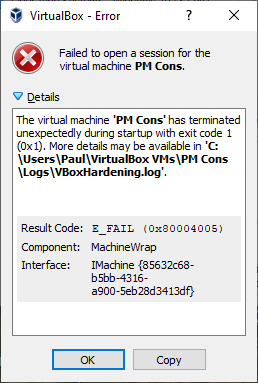
Failed to open a session for the virtual machine PM Cons.

The virtual machine 'PM Cons' has terminated unexpectedly during startup with exit code 1 (0x1).  More details may be available in 'C:\Users\Paul\VirtualBox VMs\PM Cons\Logs\VBoxHardening.log'.

Result Code: E_FAIL (0x80004005)
Component: MachineWrap
Interface: IMachine {85632c68-b5bb-4316-a900-5eb28d3413df}
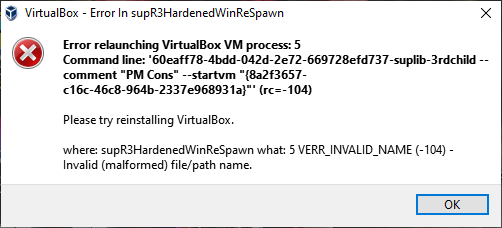
Solutions
- Solution 1
- Uninstall vb
- Reboot
- Install vb
- Set that service state to ... (vboxdrv service ?)
- Solution 2
- Remove trusteer/rapport
- Reboot and check
- Remove other security products
- Reboot and check
Notes
- VBoxDrv does not exist on my system (registry or files)
C:\Program Files\Oracle\VirtualBox\drivers\vboxdrv\
- where: supR3HardenedWinReSpawn what: 5 VERR_INVALID_NAME (-104) - Invalid (malformed) file/path name.
- FIX: VirtualBox Error in supR3HardenedWiReSpawn - Error relaunching VirtualBox VM process 5 (Solved) - WinTips.org
- This tutorial contains instructions to solve the VirtualBox Error in supR3HardenedWiReSpawn. Error relaunching VirtualBox VM process: 5.
- This shows the vboxdrv in the pictures and location
- https://forums.virtualbox.org/viewtopic.php?t=96085
- Oracle_VM-error at startup | Stack Overflow
- I am using Oracle vm with windows as host machine and linux on VM. I had everything working, but once i used 'power off' when it took time to start. Since i am not able to start the OS on VM. I am getting errors as below.
- disable the vboxdrv service
- windows hardening | Bleeping Computer
- https://forums.virtualbox.org/viewtopic.php?f=6&t=82277
- this might fix the issue
- https://www.ircache.net/how-to-fix-the-supr3hardenedwinrespawn-error-in-virtualbox/
- https://forums.virtualbox.org/viewtopic.php?f=6&t=82277&start=30
- trusteer/rapport can cause issues?
- many solutions
- FIX: VirtualBox Error in supR3HardenedWiReSpawn - Error relaunching VirtualBox VM process 5 (Solved) - WinTips.org
Windows XP will not boot completely or takes a long time
- This is cause by `Core isolation --> Memory intergrity`.
- Disable in windows and the Windows XP guest will boot correctly/
Nested VT-x/AMD-V Greyed out
- TL;DR
- I am running Windows 11 Pro
- I disabled: Windows Security --> Device security --> Core isolation --> Memory integrity
- I enabled the
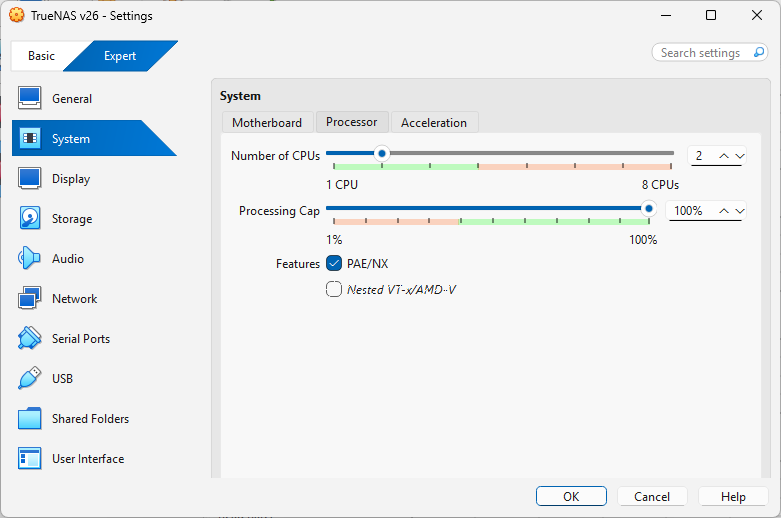
VT-x/AMD-Vsetting by using the command line:VBoxManage modifyvm "<VM name>" --nested-hw-virt on- This issue is reported here: [Bug]: Unable to enable the 'Nested VT-x/AMD-V' System option · Issue #586 · VirtualBox/virtualbox · GitHub
Nested virtualisation in VirtualBox can be unavailable for many reasons and we will work through them in a logical order below. The image blow shows you the setting we will be discussing
Hardware Support
As of VirtualBox 6.1.0, support for hosts that don't have VT-x or AMD-v have been dropped, and VT-x/AMD-v is required for all VMs.
Causes
- Causes
- Does your CPU support virtualisation.
- It is very likely, as most modern processors have this feature.
- VT-x / AMD-v has been added to CPUs thing since around 2010.
- Intel 2nd Gen (VT-x, VT-d) + Ryzen 1000 series (AMD-V, IOMMU) and up = have the VT technologies.
- Does Your CPU support Nested Virtualisation.
- In the early days this was not a feature.
- Does your CPU support virtualisation.
- Checks
- Does My Processor Support Intel® Virtualization Technology? - Provides methods to determine if your processor supports Intel® Virtualization Technology (Intel® VT).
- Intel® Product Specifications
- Intel® product specifications, features and compatibility quick reference guide and code name decoder. Compare products including processors, desktop boards, server products and networking products.
- Use this to look up your processors specs.
- Intel® Processor Identification Utility - Windows* Version
- This download page contains Intel® Processor Identification Utility for Windows*.
- Version 8.1.54 that supports 7th Gen and newer processors.
- It gives basic information about virtualisation.
- Intel® Core™ i5-1135G7 Processor - Intel® Core™ i5-1135G7 Processor (8M Cache, up to 4.20 GHz) quick reference with specifications, features, and technologies.
- My Example CPU
- Notes
- If you are running a VM in VirtualBox, then the answer is yes, but it might not support nested virtualisation.
Enabled in the BIOS?
- Causes
- Is it enabled in the BIOS?
- Some BIOSes have a separate options for nested virtualisation.
- Checks
- Login to the BIOS and make sure all virtualisation options are on.
Check for Virtualisation support in Windows
So now we have verified our hardware supports the virtualisation features we need, we should now check Windows and VirtualBox.
Check VirtualBox mode (is there a green turtle)
- This is a very simple check to see where the virtualisation is at for VirtualBox
- Table 5-1 Virtual Machine Status Bar Icons - Working with Virtual Machines - You can see the icons up close here.
- VirtualBox has 2 modes it can un its "Execution Engine" in, and this is easily shown by the CPU icon in the status bar at the bottom when you start a virtual machine up.
- Execution Engine: VT-x/AMD-V
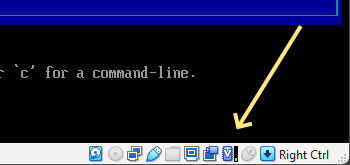
- VirtualBox is using native hardware virtualization.
- This is the "normal" mode and all CPU features are exposed to VirtualBox.
- Execution Engine: native API
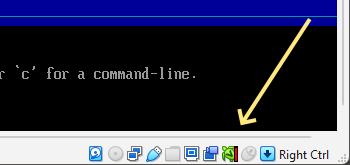
- Some Hyper-V component is active, VirtualBox tries to use the Native Execution Manager (NEM) mode.
- A green turtle icon indicates that a native hypervisor, such as Hyper-V, is running on the host.
- This is where the reference to the green turtle comes from. Implication it is working but slower that it could.
- This will mode runs slower than the native mode.
- It allows you to keep core isolation on for more security but you cannot do nested virtualsation.
- Using Hyper-V with Oracle VirtualBox - Advanced Topics | Oracle
- Oracle VirtualBox can be used on a Windows host where Hyper-V is running but host systems might experience significant Oracle VirtualBox performance degradation.
- Assuming Windows Hypervisor Platform is running, Oracle VirtualBox detects Hyper-V automatically and uses Hyper-V as the virtualization engine for the host system.
- The CPU icon in the VM window status bar indicates that Hyper-V is being used.(i.e. it is a turtle)
- Execution Engine: VT-x/AMD-V
What is causing Hyper-V to be running in Windows?
- Hyper-V can be running for many reasons, not just for directly running VMs.
- Hyper-V for directly running VMs (not sure what the name is)
- Virtual Machine Plattform
- Windows-Hypervisor-Platform
- Windows Sandbox
- Windows-Subsystem for Linux (WSL2)
- Virtualization-based security (VBS/Core isolation)
- This can get enabled when people upgrade their Windows 11.
- Docker
- There might be a way to get Nested Virtualisation working with Hyper-V and VirtualBox, I just have not found it yet.
Diagnostics
We can now use these techniques and software below to help identify the cause of Hyper-V to be running.
VBoxManage list hostinfocan be used to show exactly what features VirtualBox can seeC:\Program Files\VirtualBox>VBoxManage list hostinfo Host Information: Host time: 2026-08-31T07:38:38.409000000Z Processor online count: 8 Processor count: 8 Processor online core count: 4 Processor core count: 4 Processor supports HW virtualization: yes Processor supports PAE: yes Processor supports long mode: yes Processor supports nested paging: yes Processor supports unrestricted guest: no Processor supports nested HW virtualization: no Processor supports virt. vmsave/vmload: no Processor#0 speed: unknown Processor#0 description: 11th Gen Intel(R) Core(TM) i5-1135G7 @ 2.40GHz Processor#1 speed: unknown Processor#1 description: 11th Gen Intel(R) Core(TM) i5-1135G7 @ 2.40GHz Processor#2 speed: unknown Processor#2 description: 11th Gen Intel(R) Core(TM) i5-1135G7 @ 2.40GHz Processor#3 speed: unknown Processor#3 description: 11th Gen Intel(R) Core(TM) i5-1135G7 @ 2.40GHz Processor#4 speed: unknown Processor#4 description: 11th Gen Intel(R) Core(TM) i5-1135G7 @ 2.40GHz Processor#5 speed: unknown Processor#5 description: 11th Gen Intel(R) Core(TM) i5-1135G7 @ 2.40GHz Processor#6 speed: unknown Processor#6 description: 11th Gen Intel(R) Core(TM) i5-1135G7 @ 2.40GHz Processor#7 speed: unknown Processor#7 description: 11th Gen Intel(R) Core(TM) i5-1135G7 @ 2.40GHz Memory size: 16103 MByte Memory available: 5099 MByte Operating system: Windows 11 Operating system version: 10.0.26200.8655 C:\Program Files\VirtualBox>
- The example above was run with Core Isolation on.
- Windows Task Manager
- Open up Task Manager
- Got to the Performance tab
- Select CPU
- At the bottom right you will see a "Virtulaisation" setting displayed.
- msinfo32
- Shows Virtualisation-based security (VBS) is running
- Coreinfo
CoreinfoEx64.exe(from Windows)- Shows the status of various CPU and windows features including if the Hypervisor is present.
coreinfo -v(from the command prompt)D:\>coreinfo -v Coreinfo v4.02 - Dump information on system CPU and memory topology Copyright (C) 2008-2026 Mark Russinovich Sysinternals - www.sysinternals.com Note: Coreinfo must be executed on a system without a hypervisor running for accurate results. 11th Gen Intel(R) Core(TM) i5-1135G7 @ 2.40GHz Intel64 Family 6 Model 140 Stepping 1, GenuineIntel Microcode signature: 000000BE Processor signature: 000806C1 Maximum implemented CPUID leaves: 0000001B (Basic), 80000008 (Extended). Maximum implemented address width: 48 bits (virtual), 39 bits (physical). HYPERVISOR * Hypervisor is present VMX - Supports Intel hardware-assisted virtualization EPT - Supports Intel extended page tables (SLAT) URG - Supports Intel unrestricted guest D:\>
- Information returned is limited to virtualisation.
- As you can see here the hypervisor is present and the other virtualisation options are not available.
coreinfowithout the-vswitch will show a lot more info.
- systeminfo.exe
Virtualization-based security: Status: Running Required Security Properties: Available Security Properties: Base Virtualization Support DMA Protection UEFI Code Readonly SMM Security Mitigations 1.0 Mode Based Execution Control APIC Virtualization Services Configured: Hypervisor enforced Code Integrity Services Running: Hypervisor enforced Code Integrity App Control for Business policy: Enforced App Control for Business user mode policy: Off Security Features Enabled: Hyper-V Requirements: A hypervisor has been detected. Features required for Hyper-V will not be displayed.- In the results you will see these 2 sections that can be used to see if Hyper-V and Virtualization-based security (VBS/Core isolation) are running.
- "A hypervisor has been detected. Features required for Hyper-V will not be displayed" - This means Hyper-V is running and this will prevent nested virtualization.
- You can also get a shorter version using
systeminfo | find "Virtualization"
- bcdedit /enum
- run this from the command prompt.
- Look for
hypervisorlaunchtype — Automeans Windows' hypervisor is set to launch at boot.
- Rule out third-party hypervisors
- If you run VMware Workstation, VirtualBox, Docker Desktop, or WSL2, any of those can install/enable a hypervisor layer too. Check:
Get-Service | Where-Object {$_.Name -match 'vmms|vmcompute|WSL|VBoxSVC|vmware'} - and Task Manager → Performance tab → CPU should show "Virtualization: Enabled" — not diagnostic on its own, but if Hyper-V/WSL2 is installed you'll also see it under:
Get-WindowsOptionalFeature -Online | Where-Object {$_.FeatureName -match 'Hyper-V|VirtualMachinePlatform|Containers'}
- If you run VMware Workstation, VirtualBox, Docker Desktop, or WSL2, any of those can install/enable a hypervisor layer too. Check:
Disable all instances of Hyper-V
If you go through the tutorials at the end they will direct you any additional processes you might need, but the one I did.
This allows the relevant CPU functions to be passed directly to VirtualBox rather than being grabbed by Hyper-V which in turn does not supply nested virtulisation.
- Disable Core isolation
- Windows Security --> Device security --> Core isolation --> Memory integrity
- Modern Windows systems use this tech for security. Core Isolation and Memory Integrity give hypervisor-based protection. This makes threats like rootkits harder to execute.
- But these features may conflict with some VM software. For example, VirtualBox can produce an error with Memory Integrity on. In that case, you can turn it off temporarily. But accept the security risk.
- Keep Core Isolation off on dev machines. I leave it on for production systems. This balance gives both performance and safety.
- Windows Security --> Device security --> Core isolation --> Memory integrity
Cannot enable VT-x/AMD-V in the VirtualBox GUI
We have to enable the setting using the command line. From the outside this does seem like a bug, but perhaps my new laptop is not new enough.
Fix
- Enable the
VT-x/AMD-Vsetting by using the command line:VBoxManage modifyvm "<VM name>" --nested-hw-virt on
Cause
- Virtualbox enable nested vtx/amd-v greyed out | Stack Overflow
- From Ticket : This behavior is actually a known issue for your kind of CPU.
- These models lack a certain feature called VMCS shadowing which improves nested HW virt performance tremendously, it will be terrible otherwise. That is the reason it is not available from the GUI.
- VBoxManage however is meant as a tool to even make VM config changes which can break the VM and it is assumed the user knows what he or she is doing. Thats why it is possible to enable it from VBoxManage but performance is expected to be abysmal.
- https://forums.virtualbox.org/viewtopic.php?f=1&t=98708&p=478598#p478598
- The VirtualBox Manager allows the user to change the Enable Nested VT-x/AMD-V checkbox (under System > Processor), only if the VMCS Shadowing CPU feature is available, and prevents the user from doing so otherwise. (Actually, the VirtualBox Manager checks the availability of all 4 CPU features involved, but this distinction is not important here.) In consequence, VirtualBox V1 can run VirtualBox V2 with G2 efficiently.
- The
VBoxManage modifyvm <VM name> --nested-hw-virt oncommand enables Nested VT-x, irrespectively of the availability of the VMCS Shadowing CPU feature, and can therefore be used to circumvent the restrictions of the VirtualBox Manager method. This is equivalent to saying "I know what I'm doing!". In consequence, VirtualBox V1 cannot run VirtualBox V2 with G2 efficiently if the VMCS Shadowing CPU feature is not available.
Research Links
While researching this I came across these articles.
- General
- Other help
- https://forums.virtualbox.org/viewtopic.php?t=106620
- I would expect not, since VirtualBox has no access to VT-x if Hyper-v is in use.
- Correct. Hyper-V does not even provide VT-x/AMD-V to its root partition executing the "native" Windows. In consequence, VirtualBox has no access to VT-x/AMD-V at all.
- That's what the VirtualBox User Manual states. SLAT (Second Level Address Translation) (also called EPT (Extended Page Tables)) support probably is one of the reasons. Another reason may be that some hypervisor vendors do not want to support vendor-independent nesting for a lot of possible reasons.
- Hyper-v in Virtualbox by Bas Wijdenes Tutorial Blog - Hyper-V cannot be installed: The processor does not have required virtualization capabilities. In this post I explain how to install Hyper-v in Virtualbox.
- [VirtualBox] - Unable to use nested VT-x/AMV-V Abilities flags - virtualbox.org - No meta description
- 3.7. Nested Paging and VPIDs | Oracle - Nested paging implements some memory management in hardware, which can greatly accelerate hardware virtualization since these tasks no longer need to be performed by the virtualization software.
- https://forums.virtualbox.org/viewtopic.php?t=106620
- Enable VT-x/AMD-V Tutorials
- How to Enable Virtualization: VT-x & SVM Settings! | SYSNETTECH
- Learn step-by-step how to enable Intel VT-x and AMD-V virtualization in BIOS. Discover quick fixes for laptop and desktop systems!
- A very in-depth article.
- Recent VirtualBox versions can work with Hyper-V.
- But performance drops in every case.
- I usually turn off Hyper-V in test setups. This lets other hypervisors run at full speed.
- Rootkit Protection and Core Isolation Connection
- Modern Windows systems use this tech for security. Core Isolation and Memory Integrity give hypervisor-based protection. This makes threats like rootkits harder to execute.
- But these features may conflict with some VM software. For example, VirtualBox can produce an error with Memory Integrity on. In that case, you can turn it off temporarily. But accept the security risk.
- I usually keep Core Isolation off on dev machines. I leave it on for production systems. This balance gives both performance and safety.
- How to Enable Intel VT-x in Your Computer's BIOS or UEFI Firmware | How-To-Geek - Modern CPUs include hardware virtualization features that help accelerate virtual machines created in VirtualBox, VMware, Hyper-V, and other apps.
- Enable Nested VT-x/AMD-V grayed out in VirtualBox | TheWindowsClub - If you fail to enable nested virtualization or the Enable Nested VT-x/AMD-V option is grayed out in VirtualBox, here is how you fix the problem in Windows 11/10 PC.
- VT-x is disabled in the BIOS for all CPU modes (VERR_VMX_MSR_ALL_VMX_DISABLED) | TheWindowsClub - Fix Failed to open a session for the virtual machine, VT-x is disabled in the BIOS for all CPU modes (VERR_VMX_MSR_ALL_VMX_DISABLED), 0x80004005.
- How to enable nested virtualization in VirtualBox | MUNDObytes
- Enable nested virtualization in VirtualBox step by step, avoid errors with Hyper‑V, and optimize your lab. A practical and detailed guide.
- The VT-x/AMD-V checkbox appears grayed out: use VBoxManage with the VM powered off to enable nesting, as we've seen. It may still be grayed out in the GUI, but the flag remains active and functions correctly.
- VERR_VMX_NO_VMX error: The host does not expose virtualization extensions to the VirtualBox process. Disable Hyper-V if you don't need it, adjust security (Memory Integrity), and restart after each change.
- Poor performance with Hyper-V enabled: This is normal due to the compatibility layer (turtle icon in VirtualBox).
- How to Enable Nested VT-X/AMD-V in Virtualbox [Step by Step] | CyberITHub - In this article, I will explain how to enable Nested VT-X/AMD-V in Virtualbox. Last night when I was trying to bring up a VM using vagrant in my Ubuntu system
- How to Fix 'Virtualized VT-x/EPT Is Not Supported on This Platform' Error on Windows 11 - SwitchFirewall
- Several factors can trigger the VT-x/EPT error on Windows 11:
- Virtualization not enabled in BIOS/UEFI: Hardware virtualization must be activated at the firmware level
- Hyper-V conflicts: Windows Hyper-V can interfere with other virtualization platforms
- Nested virtualization disabled: The host VM doesn't have nested virtualization enabled
- Windows security features: Core Isolation and Memory Integrity can block virtualization
- Outdated hypervisor software: Running old versions of VMware or VirtualBox
- Several factors can trigger the VT-x/EPT error on Windows 11:
- GitHub - AnzeuS/Solution-to-Intel-VT-x-EPT-Problem-in-VMware-and-VirtualBox
- This guide explains how to resolve the issue related to the nested virtualization option in VMware and VirtualBox.
- This solution was tested on Windows 11 Pro with an Intel i5 12th generation processor.
- How to enable Virtualbox nested VTX/Amd-V on Windows 10/11 or Linux - H2S Media - Here in this tutorial, we let you know the command to enable nested VTX/Amd-V option on VirtualBox if that appears grey and you are unable to check its box.
- VirtualBox enable nested VT-x/AMD-V greyed out: How to fix - YouTube - How to enable nested virtualization in VirtualBox
- Fix VirtualBox VT-x Is Not Available (Hyper-V Conflict) | MCSA Guru - VirtualBox says VT-x is not available (VERR_VMX_NO_VMX)? Here's how to free your CPU virtualization from Hyper-V, Memory Integrity, and WSL2 — and fix it for good.
- How to Enable Virtualization: VT-x & SVM Settings! | SYSNETTECH
- Remove Green Turtle
- These are very similiar as the "Enable VT-x/AMD-V Tutorials" links above but with more of a focus on perfomance. They will go over the same ground.
- VirtualBox - Green Turtle Issue | Kicksecure - Fix VirtualBox green turtle icon issue on Windows hosts caused by Hyper-V and VBS. Learn how to improve VM performance and stability with step-by-step instructions.
- Green turtle/Snail Mode (Slow Performance indicator) on VirtualBox VM | Super User - So the green turtleSnail mode for "emulation mode" remains stubbornly active.
- Tool to fix turtle icon (Hyper-V conflict) and restore full VirtualBox speed - virtualbox.org - I created a small portable executable to fix the turtle icon issue caused by Hyper-V and related Windows features interfering with VirtualBox.
- How to get rid of the green turtle icon (slow mode) for VirtualBox on Windows 11 · GitHub - Is your VM intolerably slow? Does the green turtle icon haunt the lower right corner of your screen? Well, this guide's for you, my friend.
- Fix the VirtualBox Green Turtle Icon on Windows | MCSA Guru
- The green turtle in your VirtualBox status bar means the VM is running on Hyper-V's slow execution mode, not native VT-x. Here's how to get native speed back.
- Your VirtualBox VM still boots and runs, but it feels sluggish, and there’s a small green turtle sitting in the status bar at the bottom of the VM window. It’s easy to ignore. You shouldn’t.
- VirtualBox runs VMs in one of two modes on Windows. In native mode, it grabs the CPU’s VT-x (Intel) or AMD-V (AMD) extensions and talks to the processor directly — fast, the way it’s meant to work. In Hyper-V execution mode, the Windows hypervisor already owns those extensions, so VirtualBox sits on top of the Windows Hypervisor Platform API and runs the VM as a guest of Hyper-V.
- The second mode works, but there’s a performance cost because virtualization calls pass through an additional layer. The turtle icon appears whenever VirtualBox detects it’s in that fallback mode. No turtle means native VT-x; turtle means Hyper-V backend.
- Windows
- How to Disable VBS and Speed Up Windows 11 or 10 | Tom's Hardware - Virtualization Based Security can slow apps (and games) down by 5 to 15%.
- Enable Intel VT-x / AMD-V in BIOS (Windows 10/11) 2026 - Step-by-step instructions for enabling hardware virtualization in BIOS/UEFI on Windows 10/11. Covers ASUS, Dell, HP, Lenovo, MSI, Acer, and what to do when the option is missing or locked.
- Android Emulator Without Virtualization (Windows 10/11) 2026 - Step-by-step guide to running BlueStacks, MuMu, NoxPlayer, GameLoop, and LDPlayer on Windows 10/11 when VT-x, AMD-V, or Hyper-V is disabled, blocked, or unavailable.
- Your CPU supports VT-x but it's disabled in BIOS. Reboot, enter UEFI, flip the toggle, done. See our BIOS enablement guide.
- Your CPU supports VT-x but Hyper-V or another hypervisor is hogging it. Disable Hyper-V (or use a Hyper-V-aware emulator like BlueStacks 5.20+ or MuMu Player 12). Covered below.
- Your CPU genuinely cannot do VT-x — old laptop, locked vPro firmware, employer-disabled BIOS option, Celeron/Atom from the early 2010s. This is the hard case, and only a small set of emulators work. Covered below.
- What is Nested Virtualization for Hyper-V? | Microsoft Learn - Nested virtualization in Hyper-V lets you run Hyper-V inside a VM. Learn how it works, supported scenarios, and when to use it in your environment.
- I cannot enable the nested VT-x/AMD-V to both VMWare Workstation and Virtualbox using Windows 11 Pro. - Microsoft Q&A
- I cannot enable the nested virtualization VT-x/AMD-V to both VMWare Workstation and Virtualbox (already in latest versions) using my Windows 11 Pro.
- To enable nested virtualization for VirtualBox or VMware Workstation, Hyper-V need to be disabled on Windows. Please open Windows PowerShell or Command Prompt as administrator, run bcdedit and make sure hypervisorlaunchtype is set to Off.
bcdedit /set hypervisorlaunchtype Off
- Hyper-V Nested Virtualization Troubleshooting Guide - Windows Server | Microsoft Learn - Provides a structured approach for troubleshooting nested virtualization issues in physical and cloud-based environments.
- System Requirements for Hyper-V on Windows and Windows Server | Microsoft Learn
- Learn about the hardware and firmware requirements for Hyper-V in Windows and Windows Server.
- Windows 11 VBS: Fix Missing VT-x/VT-d in VMware/VirtualBox (WHPX, Nested Virtualization, GPU Passthrough) | IT trip
- On Windows 11, “VT-x/AMD‑V” and “VT-d/IOMMU” can look like they’ve vanished inside VMware Workstation or VirtualBox—especially when Virtualization‑Based Security (VBS) / Memory Integrity is enabled.
- The short version: VBS starts the Windows hypervisor, and once Windows owns the CPU virtualization extensions, third‑party hypervisors can’t talk to VT-x/VT-d directly.
- They must run “on top” via Windows Hypervisor Platform (WHP/WHPX), which can allow some nested virtualization, but effectively blocks true PCIe passthrough.
- Windows 11 24H2 update and Workstation Pro cannot do nested virtualization | VMware Workstation - HI, I just have updated windows 11 to 24H2 and after that when i try to launch esxi as a virtual machine in workstation pro 17.6.1 I am getting following error
- How to Properly Disable Virtualization-Based Security (VBS) in Windows 11 24H2 - Jaspreet Singh
- With the introduction of Windows 11 version 24H2, some users have noticed that even after turning off Memory Integrity and other security features, Virtualization-Based Security (VBS) continues to run. This can have a negative impact on CPU performance, especially for users with AMD systems or those who rely on high-performance computing, such as gamers.
- Disabling Memory Integrity alone does not completely turn off VBS. To restore full CPU performance, you must disable VBS through the registry. Follow the steps below to do this.
- Enable memory integrity / Enable virtualization-based protection of code integrity | Microsoft Learn - This article explains the steps to opt in to using memory integrity on Windows devices.
- How to Enable Nested Virtualization in Hyper-V (2025 Update) - Jasmin Kahriman - IT Pro, Blogger & Educator - Learn how to enable nested virtualization in Hyper-V Server with this step-by-step PowerShell guide. Includes prerequisites and commands.
- Nested Virtualization on Windows 11: The VBS Conflict Explained - DEV Community
- After upgrading to a modern system with full virtualization support — including VT-x, EPT, IOMMU, TPM 2.0, and Secure Boot — I expected everything to work flawlessly. Instead, I encountered crashes and instability when running nested virtualization scenarios, particularly when attempting to run VMware inside VMware Workstation Pro.
- The Problem: VMware Nested Virtualization Failures
- Understanding the Root Cause: VBS
- Virtualization-Based Security (VBS) is fully integrated into Windows 11's kernel and takes exclusive control of VT-x/AMD-V. This prevents desktop hypervisors from accessing hardware virtualization directly, causing conflicts with nested virtualization.
Questions
- Is it possible to keep the Hyper-V running to allow for the benefits of core isolation but with the ability to use nested virtualisation? Speed is nto an issue.